Design thinking is widely taught as a universal innovation method. Many frameworks were developed in Western contexts. But how does design thinking actually work inside Korean companies?
In a recent paper with Seamus Yu Harte from the Stanford d.school, we examined this question by analyzing 1,117 practitioner quotes from industry lectures given by executives and managers from companies such as LG Electronics, Hyundai Motors, SK Telecom, and Kakao.
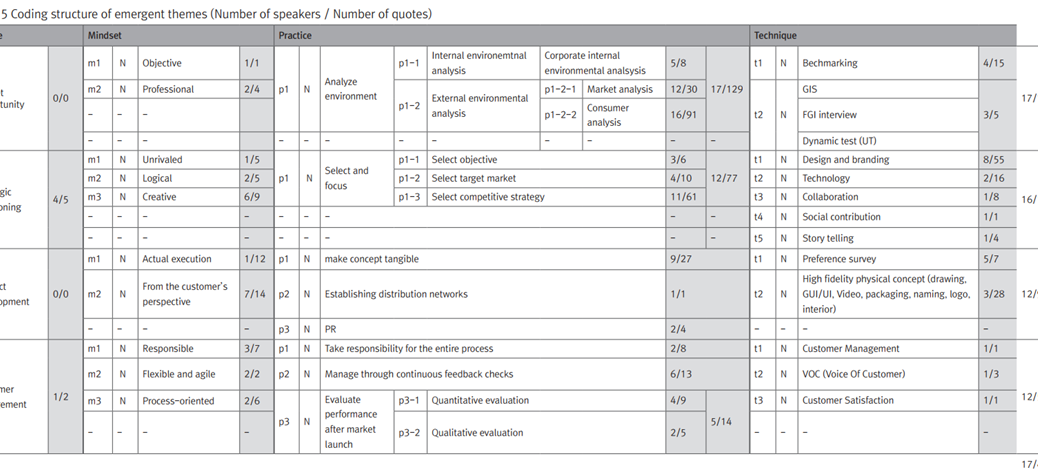
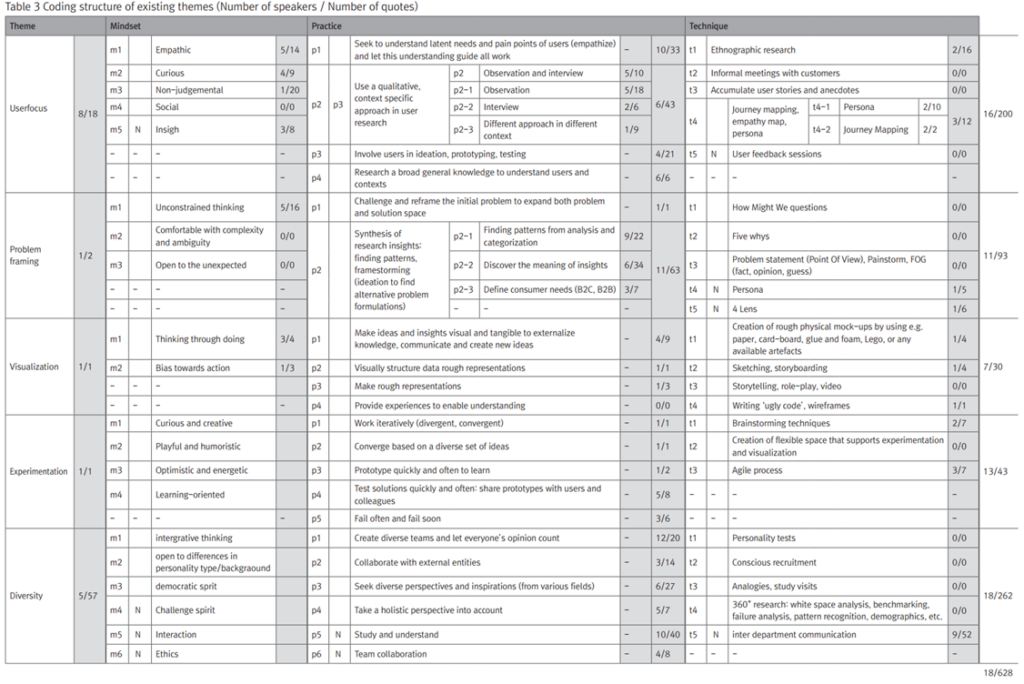
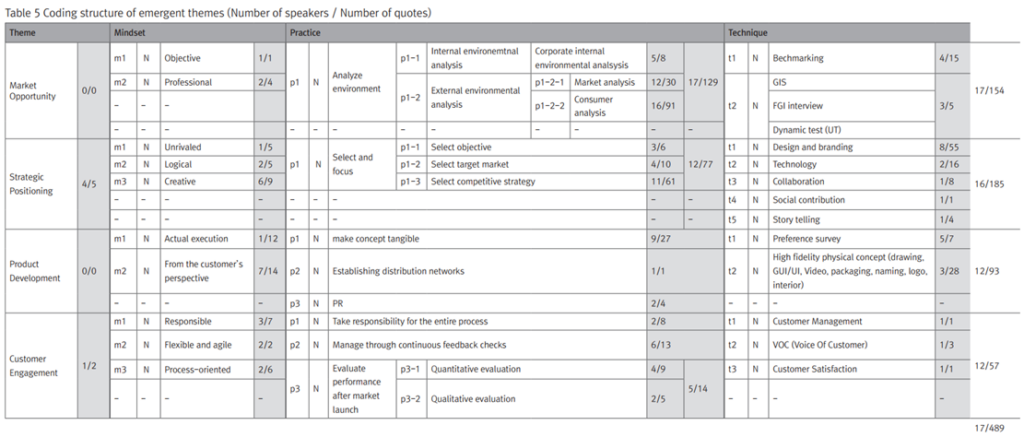
About 56% of the quotes matched the well known five themes of design thinking (e.g., user focus, problem framing, visualization, experimentation, and diversity). However, 44% did not fit this framework. Instead, four new themes emerged from the quotes: market opportunity, strategic positioning, product development, and customer engagement. These findings suggest that Korean practitioners extend design thinking beyond early stage ideation to adapt it into a strategic and operational management tool.
Background: Design thinking frameworks developed in Western contexts may not fully capture how these approaches are adapted in different cultural and organizational settings. In South Korea, where businesses tend to be execution focused and hierarchical, the practice of design thinking may evolve in unexpected ways. This study addresses the gap by investigating how Korean professionals interpret and apply design thinking within their unique organizational cultures.
Methods: We conducted a qualitative analysis of 1,117 practitioner quotes collected from 18 guest lectures on design thinking delivered to Korean business school students between 2015 and 2021. Using the Carlgren et al. (2016) five-theme framework as an analytical lens (user focus, problem framing, visualization, experimentation, and diversity), we coded all quotes and identified both aligned and emergent themes.
Results: Findings show that 56% of the quotes aligned with Carlgren et al. five themes, while 44% revealed four new themes: Market Opportunity, Strategic Positioning, Product Development, and Customer Engagement. These emergent themes suggest that Korean practitioners adapt design thinking into a strategic and operational management tool to align with demands like ppalli-ppalli (speed) and Chaebol hierarchy. Furthermore, we propose a layered conceptual model (Mindset, Practice, Technique) to explain how design thinking is institutionalized, finding that Mindset is the least frequent but most essential precondition for organizational change.
Conclusions: The results suggest that Korean professionals adapt design thinking into a layered system that simultaneously operates at the levels of mindset, practice, and technique. This paper contributes one of the most detailed empirical studies of non-Western applications of design thinking, offering insights for scholars and practitioners seeking to navigate culturally specific innovation contexts. This work particularly contributes to cross-cultural design theory by demonstrating the operationalization of design thinking in a manufacturing-heavy economy.
Keywords: Design Thinking, Cross-Culture Adaptation, Organizational Practice, Korean Business Culture, Qualitative Analysis