When we think about behavioral design, we usually picture small, simple nudges such as changing a default setting on a screen. In academic research, these isolated changes are popular. But in the real world, many other decisions must be made before and after a single nudge is chosen. For instance, teams have to decide for whom and how a specific nudge should be applied. This gap is why I wrote a case-based paper with Philip Cash, published in the journal Designing.
We studied a design team at Samsung Electronics over a 16-week project. Their goal was to help users make better decisions within a smart home system.
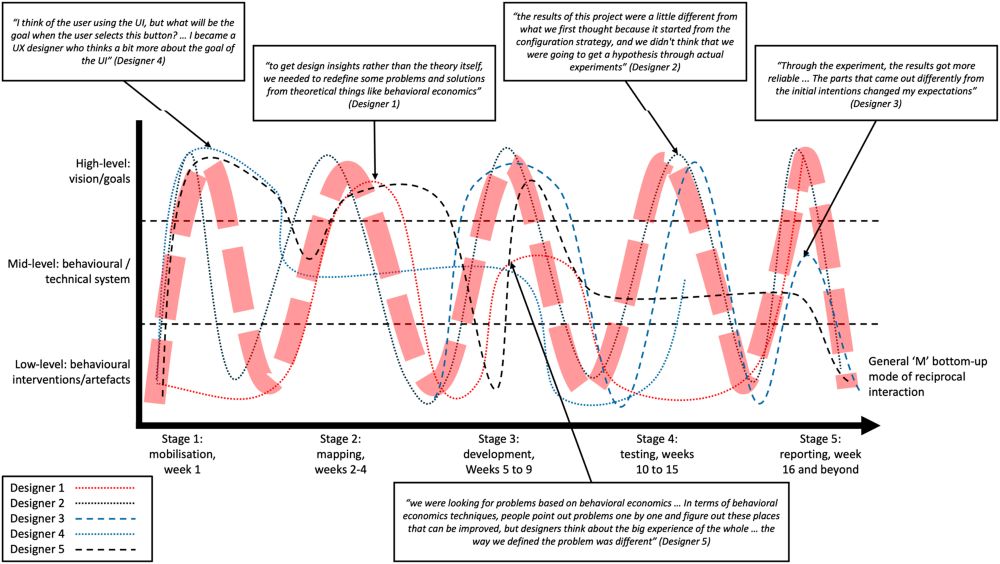
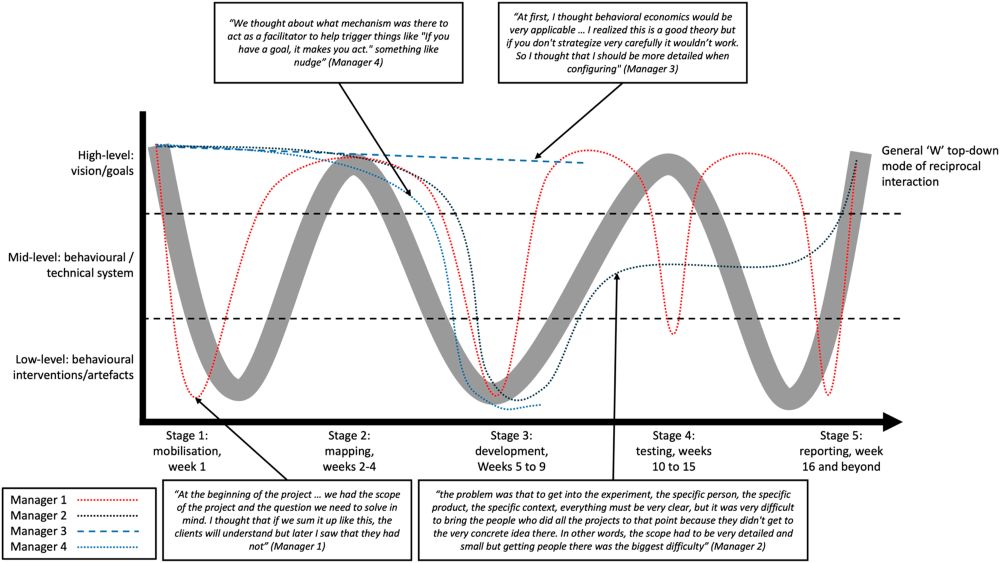
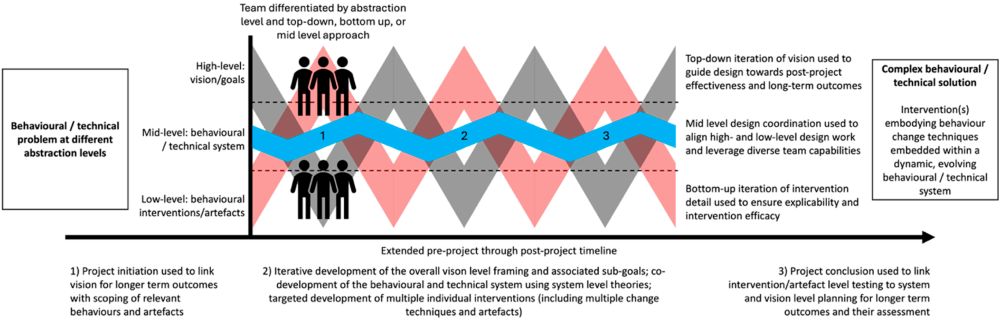
We found that the team worked across three different levels of abstraction.
High-level (vision/goals): Focusing on long-term user goals rather than short-term company metrics.
Mid-level (behavioural/technical systems): Organizing how different products connect. For example, instead of looking at home appliances as separate machines, the team grouped products into bundles to help users achieve one main goal like cleaner air at home.
Low-level (Interventions/artefacts): Managing specific design features and psychological details in the interface
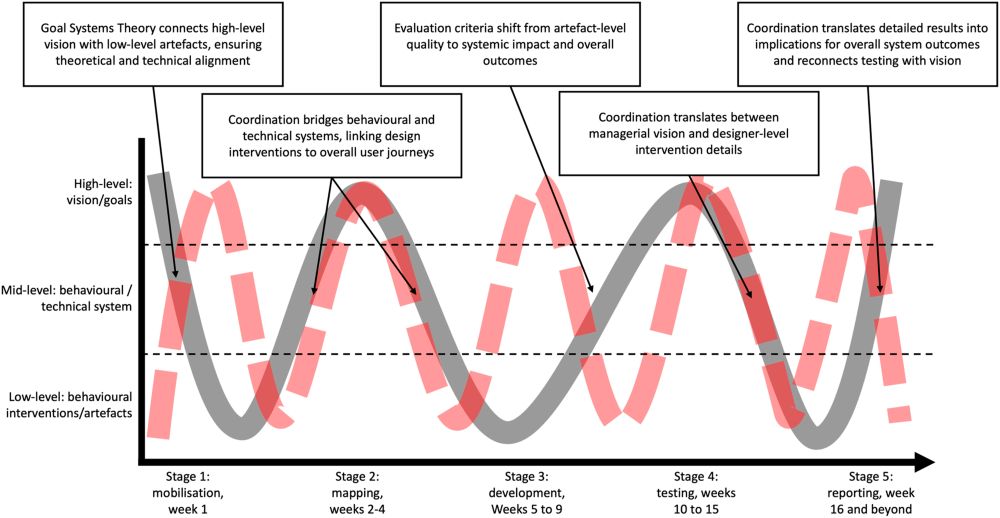
Our study also shows that team members must collaborate closely in a non-linear way. Designers (the red line in our framework) often work from the bottom up to change big goals based on design artefacts, while managers (the grey line) work from the top down to keep intervention details aligned with the vision.
The most important part of this process is mid-level coordination, which acts as the critical bridge connecting the big strategy with specific interface details.
While most nudge research simplifies the problem by focusing on either the high level or the low level, behavioural design projects in the wild must navigates all three levels simultaneously. The connection between these layers are consequential for managing process complexity.
If we want behavioral economics to be truly useful, we must change how we design. We cannot treat behavioral design as just a list of separate, simple steps. By focusing on systemic coordination instead of isolated nudges, we can help design teams handle complex projects and create real, long-term value.
Behavioural design has emerged as an important means of shaping behaviour change. Realising such change often necessitates complex combinations of multiple behaviour change interventions and multiple design artefacts. Yet, it is unclear how current practices should be adapted for such contexts. Hence, we ask: How can complexity be addressed in a behavioural design process? Through an in-depth case study, we develop several propositional insights. We theorise Complex Behavioural Design (CBD) in systemic terms and differentiate this from typical behavioural design processes by: (i) the progression of design at multiple abstraction levels requiring different design capabilities (high dealing with vision and goals; mid dealing with the behavioural/technical system; and low dealing with interventions and artefacts), (ii) the presence of both top-down and bottom-up reciprocal interactions across levels, and (iii) the need for mid-level design coordination. These significantly extend current discussions in behavioural design and point to propositional directions for future research.
“Designer 2 expressed how shifting perspectives changed his view of design itself: ‘I used to have times when design itself was my goal. But as I worked through this project, I realized that design shouldn’t be the goal. Design is a methodology for doing something’, and further that this needed to include logic from other aspects of the project: ‘you have to consider the market… since the management has a view close to the market, it will be very helpful when communicating with them’.” (pg. 10)
One thought on “Moving beyond nudges: The case of Complex Behavioural Design”
Здорова, народ Близкий человек уже несколько дней в запое Дети напуганы Таблетки не помогают Короче, единственное что вытащило из запоя — вывести из запоя анонимно с гарантией Через пару часов человек пришёл в себя В общем, вся инфа по ссылке — выведение из запоя https://narkolog.vyvod-iz-zapoya-na-domu-volgograd.ru Вывод из запоя на дому — это реальный выход Перешлите тем кто в такой же ситуации
Здорова, народ Близкий человек уже несколько дней в запое Дети напуганы Таблетки не помогают Короче, единственное что вытащило из запоя — вывести из запоя анонимно с гарантией Через пару часов человек пришёл в себя В общем, вся инфа по ссылке — выведение из запоя https://narkolog.vyvod-iz-zapoya-na-domu-volgograd.ru Вывод из запоя на дому — это реальный выход Перешлите тем кто в такой же ситуации