
Barry Schwartz argues in his book, the Paradox of Choice, that increasing choices does not make us happy. Instead, reducing choices boosts sales and giving more options lowers choices.
Autonomy and Freedom of choice are critical to our well being, and choice is critical to freedom and autonomy. Nonetheless, though modern Americans have more choice than any group of people ever has before, and thus, presumably, more freedom and autonomy, we don’t seem to be benefiting from it psychologically. —quoted from Ch.5, The Paradox of Choice, 2004
Then, does giving more choices enhance the enjoyment choosers experience? It may not be, either. I had a similar experience at the cheese section of the Annam Gourmet at Ho Chi Minh city, Vietnam. It provided a wide variety of cheeses. Therefore, spent a significant amount of time in carefully comparing multiple cheeses and eventually choosing one. When I tasted the selected cheese, unfortunately, I was confused which one to choose because I spent too much time on thinking about several cheeses.
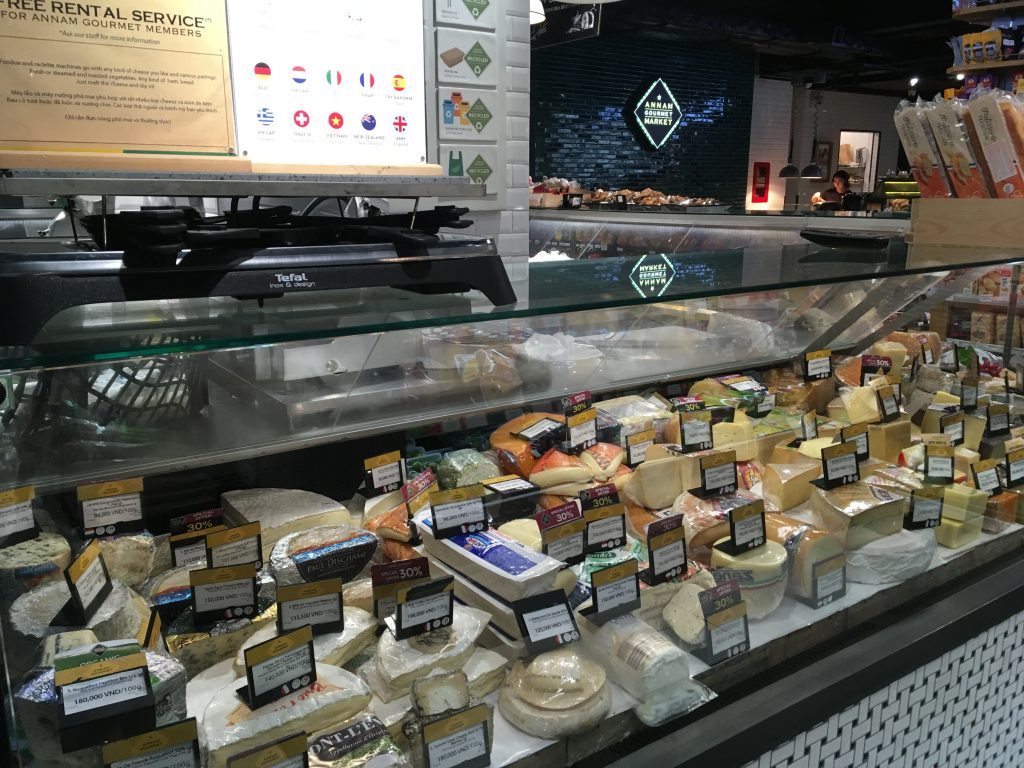
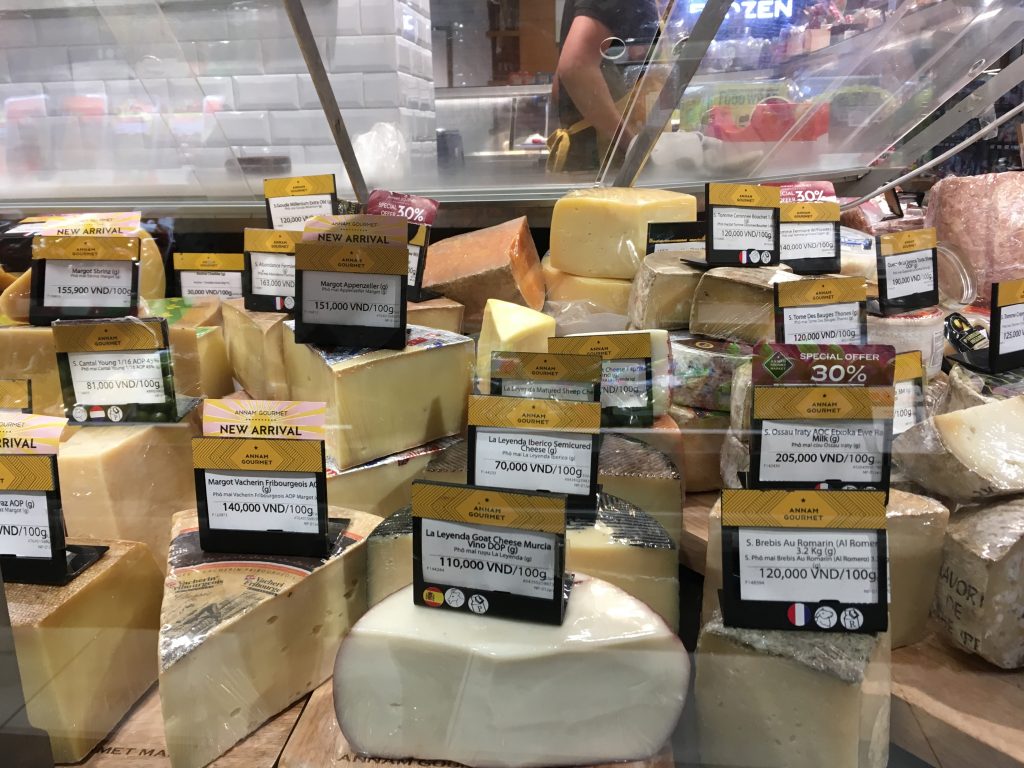
Then, what could marketers do to help people enjoy their experience? One suggestion is that when customers experience the option, they are reminded which one was chosen. For instance, if the option name is shown, customers will be able to keep focused on it.
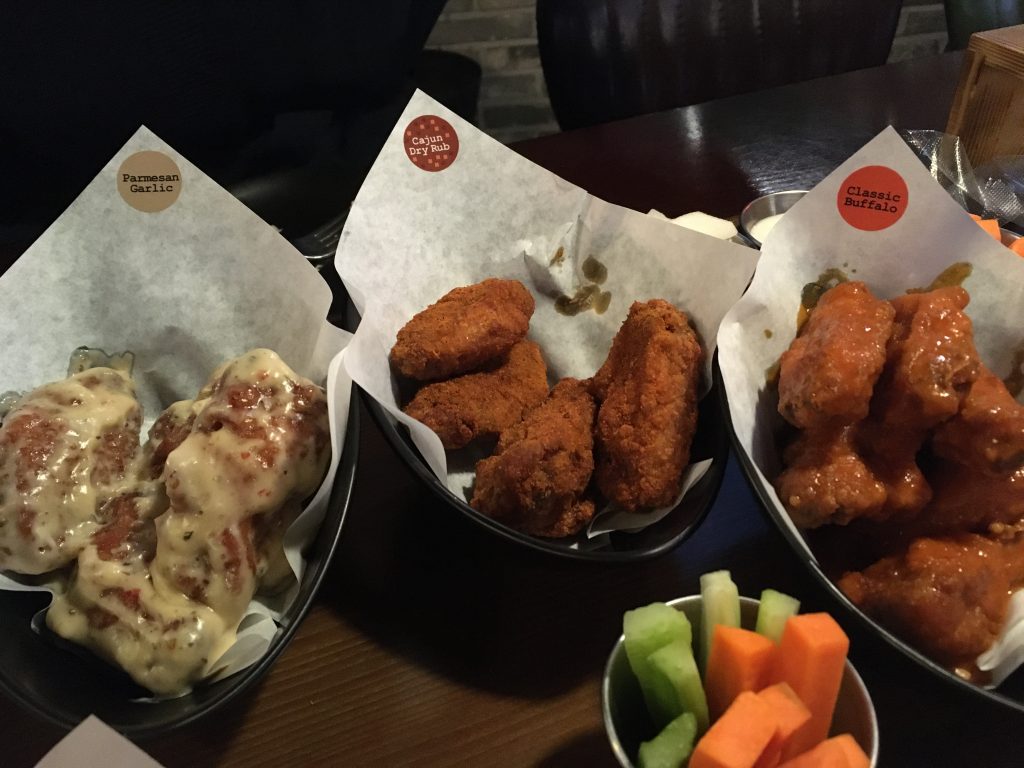
Nekkid Wings is a chicken wing restaurant in Seoul, Korea. Customers select one out of twelve flavors for a bucket of five wings. Some flavors are safe (e.g., classic buffalo) and others are risky (e.g., parmesan garlic). Most customers order multiple buckets and try safe and risky flavors together. The flavor names printed on the paper help customers focus on which flavor they are testing.
***
Reference
West, P. M., Brown, C. L., & Hoch, S. J. (1996). Consumption Vocabulary and Preference Formation. Journal of Consumer Research, 23(2), 120–135.
Consumers’ understanding of their own preferences can be aided by a “consumption vocabulary”—a taxonomy or framework that facilitates identifying the relation between a product’s features and one’s evaluation of the product. In the absence of such a vocabulary, consumers’ understanding of their own preferences will require more extensive experience and may never fully develop. The effect of such a vocabulary is tested in two experiments in which subjects provided with a vocabulary (1) exhibit better-defined and more consistent preferences than control subjects, (2) show improved cue discovery, and (3) show learning (i.e., increases in consistency over time). All results hold regardless of the functional form of the model used to assess subjects’ preference formation.
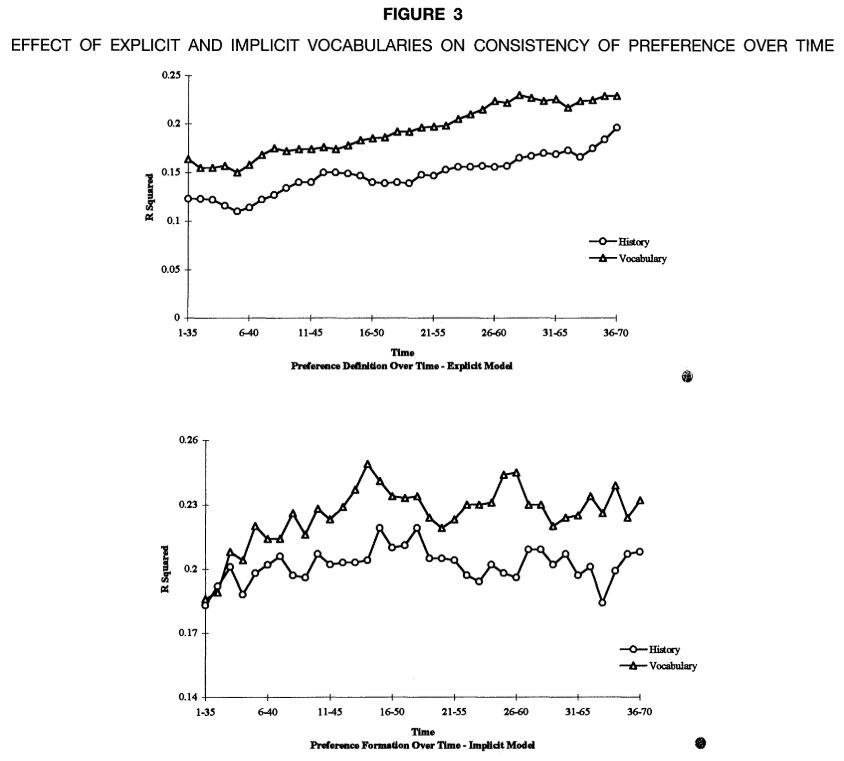
What guides us when we are faced with many choices? I believe it is detailed descriptions. In the article I read, one of the ways marketers can enrich customer experiences is by reminding customers of the options available to them. Simply having many choices does not necessarily lead to a richer experience. In fact, when people are presented with too many options, they often end up choosing what is most familiar to them. Similar to the example of selecting from a wide variety of cheeses mentioned in the article, I always choose the same flavors whenever I visit Baskin-Robbins. Although I am curious about trying new flavors, the fear of making a disappointing choice often leads me back to familiar options.
Recently, I visited a café in Yongsan. When I visit a new café, I usually order an iced Americano because it is a safe choice with a low risk of disappointment. There are many reasons for this behavior, but the main one is that I do not want to waste money on an unfamiliar drink that I might not enjoy. Since many café beverages cost close to ten dollars, trying something new can feel like a financial risk. An unfamiliar menu item is difficult to imagine, and uncertainty often translates into the possibility of disappointment. As a result, we frequently choose the comfort of familiarity over the excitement of a new experience.
However, on that particular day, something caught my attention. Normally, I would have stared at the menu for a while before eventually ordering an Americano. Instead, I noticed a drink called “Basil Tomato Ade,” and beneath its name was a brief but detailed description. It explained how the drink was made and what flavors I could expect. Unlike many other menu items that only listed their names, this thoughtful description sparked my curiosity and weakened my usual defensive approach to choosing a beverage.
More importantly, the description allowed me to imagine the taste before actually trying the drink. The words used to describe the flavors created a sensory image in my mind and helped me picture the experience of drinking it. Consumers do not simply purchase products; they also imagine the experiences those products might provide. In this sense, detailed descriptions serve a purpose far beyond simply delivering information.
Of course, detailed descriptions are more likely to attract attention when they align with flavors that consumers already enjoy. Nevertheless, it was the café’s effort to describe the drink in detail that encouraged me to step outside my comfort zone and try something new. As a result, I was able to experience a flavor combination I had never considered before. Even if the drink had not met my expectations, my range of experiences would still have expanded. Before that day, I could not imagine basil and tomato being combined in a beverage. Now, that combination exists as a possibility in my mind.
Detailed descriptions therefore do more than communicate product information. They can help consumers discover preferences they never knew they had and reduce the uncertainty that often prevents people from trying something new. This illustrates why marketers should continually remind customers of the meaning and value behind their choices. By reducing perceived risk, detailed descriptions transform new experiences from potential disappointments into opportunities for enjoyment and discovery.