When it comes to innovation, business has much to learn from design. The philosophy in design shops is, ‘try it, prototype it, and improve it’. Designers learn by doing. The style of thinking in traditional firms is largely inductive – proving that something actually operates – and deductive – proving that something must be. Design shops add abductive reasoning to the fray – which involves suggesting that something may be, and reaching out to explore it.
Because it’s pictorial, design describes the world in a way that’s not open to many interpretations. Designers, by making a film, scenario, or prototype, can help people emotionally experience the thing that the strategy seeks to describe.
Design thinking is synthetic. Out of the often-disparate demands presented by sub-units’ requirements, a coherent overall design must emerge. Design thinking is abductive in nature. It is primarily concerned with the process of visualizing what might be, some desired future state and creating a blueprint for realizing that intention. Design thinking is opportunistic: the designer seeks new and emergent possibilities. Design thinking is dialectical. The designer lives at the intersection of often-conflicting demands – recognizing the constraints of today’s materials and the uncertainties that cannot be defined away, while envisioning tomorrow’s possibilities.
In fact, design thinking always meant different things to different players. For some it was about teaching managers how to think like designers; for others, it was about designers tackling problems that used to be the preserve of managers and civil servants; and for others still, it was anything said on the subject of design that sounded smart. To most, it is was merely a new spin on design. All its proponents were, however, united by their ambition for design to play a more strategic role in the world than ‘making pretty.’ Who could argue with that?
..
Now in 2023, what is design thinking?
People are gravitated towards different attitudes about design thinking. Some are disappointed by the fact that design thinking fails to produce visible, lasting outcomes. Others pay attention to its unique role in helping people creative. Design thinking might not be a short-term, direct tool, but rather a long-term, indirect mindset.
***
Reference 1
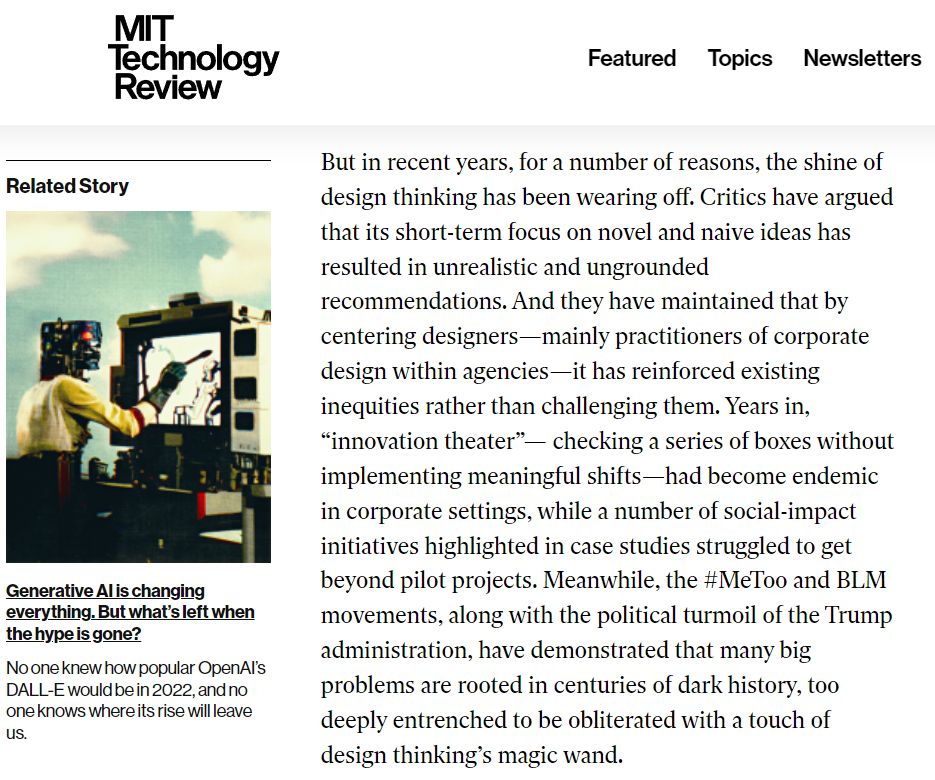
Ackermann, R. (2023). Design thinking was supposed to fix the world. Where did it go wrong. MIT Technology Review.
An approach that promised to democratize design may have done the opposite.
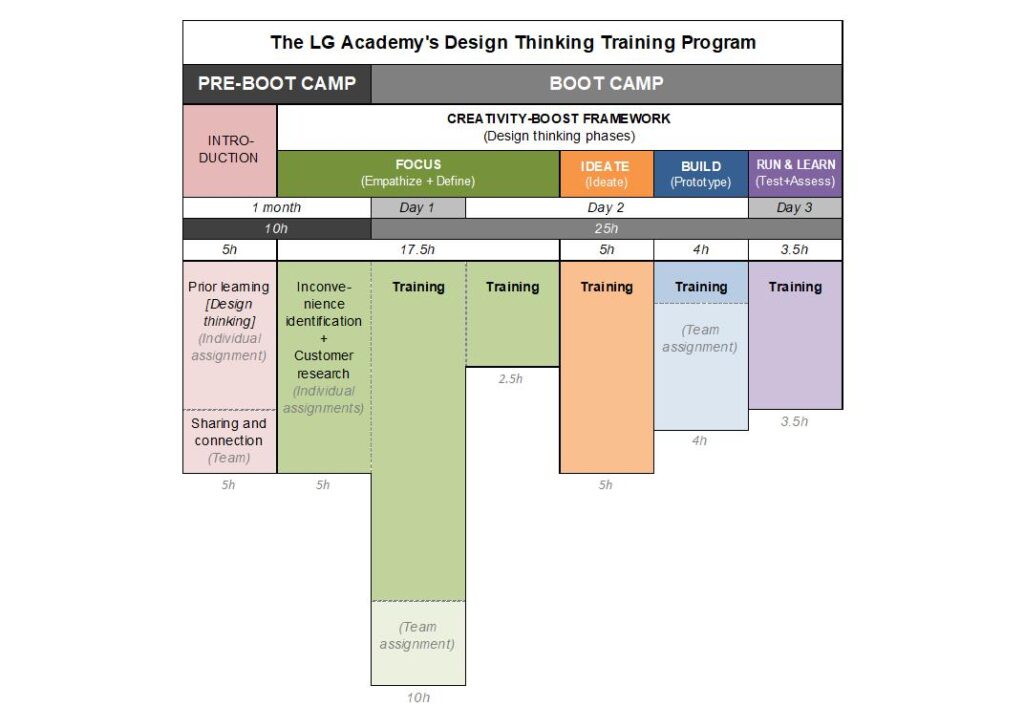
Organizations have sought to adopt design thinking aiming at innovation. However, implementing such a creative problem-solving approach based on designers’ mindsets and practices requires the navigation of obstacles. Corporate structure and culture hinder the adoption course, and cognitive barriers affect non-designer engagement. In this regard, training has been used as a means of easing the process. Although considered a crucial step in design thinking implementation, research on training initiatives is scarce in the literature. Most studies mirror that about d.school boot camp and innovative programs developed by companies globally remain unknown. This practice-oriented paper investigates a training blueprint tailored for LG Corporation in South Korea, targeting R & D personnel working in several affiliates that needed creative problem-solving skills to improve business performance. The study findings unveil a customized initiative that expanded the established boot camp model by adding preceding activities to increase learning opportunities and enable empathetic observation. Fundamentally, the customization strategy aimed to provide participants with customer-oriented tools to solve business problems. In addition, the training program reframed the design thinking steps in order to make it relevant for employees and foster corporate implementation goals. Ultimately, this case study supplies literature describing a training blueprint to disseminate design thinking considering two dimensions: individual adoption and organizational implementation challenges.
Figure 1 The overall structure and time allocation of the d.school’s design thinking training program
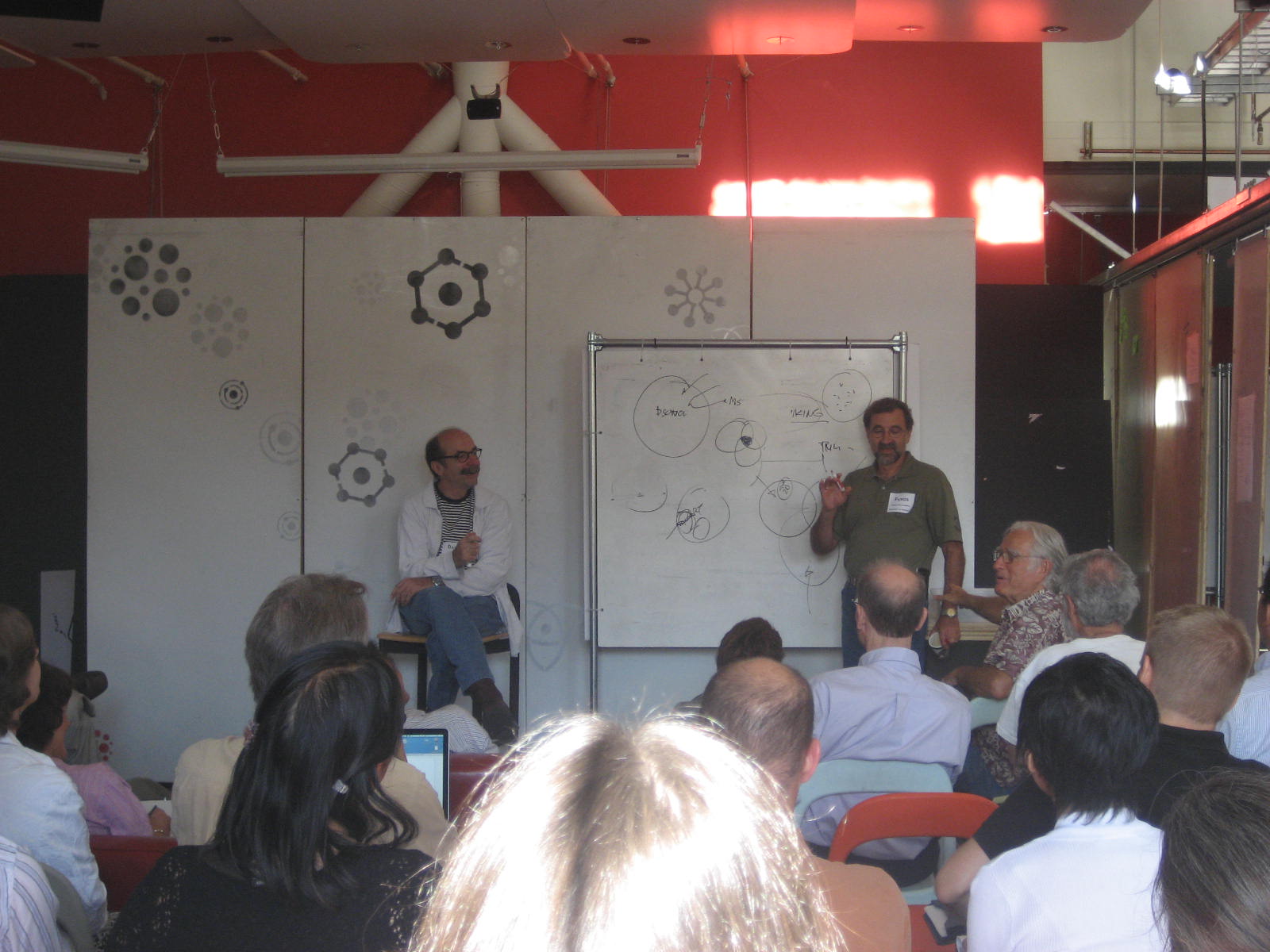
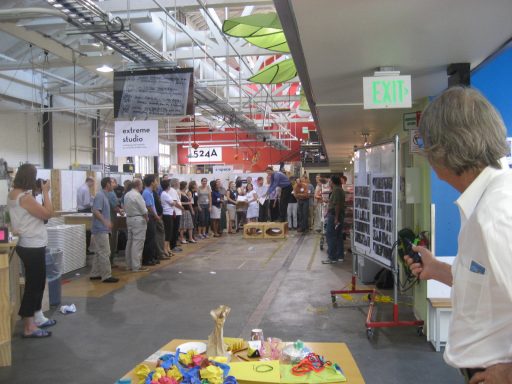
I was invited to attend the NSF Design Series Workshop called “Interdisciplinary Graduate Design Workshop: Instruction”, on August 28 – 29 at Stanford University. Participants have different backgrounds across mechanical engineering and engineering education to architecture and psychology. I am one of few participants from the business field. Information below might be of help to those who want to take a glimpse what this workshop looks like.
Participants submitted their courses in advance and made a list of the graduate-level, interdisciplinary design courses available now. I am personally amazed by the width of this area. Here are some examples (see the full list: The collected design courses).
[*=course taught by others]
Leadership By Design – Design By Collaboration Processes for Illuminating and Expanding the Box (submitted by Bruce Corson, Studio for Pre-Expert Creativity)
Designing Day One Securing a Space for Creative Collaboration (submitted by Bruce Corson, Studio for Pre-Expert Creativity)
Rube Goldbergineering (submitted by Shawn Jordan, Purdue University)
ARCH 497c DigiFAB (submitted by David Celento, Pennsylvania State University)
ARCH 497D X-Disciplinary Creativity: Smart Products for Tomorrow (submitted by David Celento, Pennsylvania State
University)
ARTGR 672 Graphic Design & Human Interaction (submitted by Sun Kang, Iowa State University)
ARTGR 672 (HCI595X) Human Interaction Design: Design for Behavioral Change (submitted by Debra Satterfield, Iowa State University)
BUS Design and Systems Thinking for MBAs (submitted by Sara Beckman, University of California, Berkeley)
BUS Design as a Strategic Business Issue (submitted by Sara Beckman, University of California, Berkeley*)
BUS Innovation, Creativity and Entrepreneurship (submitted by Sara Beckman, University of California, Berkeley*)
BUS Design Practicum, New Product and Services Lab (submitted by Jaewoo Joo, Rotman School of Management, University of Toronto*)
BUS Innovation, Foresight, and Business Design (submitted by Jaewoo Joo, Rotman School of Management, University of Toronto*)
BUS Strategic Product Design for MBA students (submitted by Mark Henderson, Arizona State University)
CEE222A: Computer Integrated Architecture/Engineering/Construction (AEC) Global Teamwork (submitted by Renate Fructer, Stanford University)
DESCI 501 Analytical Product Design (submitted by Panos Papalambros, University of Michigan)
(Design) Exhibition (submitted by Wendy Ju, California College of Arts)
(Design) Interaction Design Studio (submitted by Wendy Ju, California College of Arts)
(Design) Pulse. Topic studio (submitted by Wendy Ju, California College of Arts)
DSC 520 Contemporary Design Issues (submitted by Jacques Giard, Arizona State University)
DSC 580 Practicum: Methods of Teaching Design (submitted by Jacques Giard, Arizona State University)
DSGN 401-1 Human-Centered Design Studio 1 (submitted by Ed Colgate, Northwestern University)
DSGN 401-3: The design of services and products (submitted by Don Norman, Northwestern University)
DSGN 401-3 Human Centered Service Design (submitted by Liz Gerber, Northwestern University)
DSGN 495-20 Design Research (submitted by Ed Colgate, Northwestern University*)
DSGN 495-05 Differentiation by Design (submitted by Ed Colgate, Northwestern University*)
DSGN 495-21 Sustainable Manufacturing (submitted by Ed Colgate, Northwestern University*)
DSGN 495 Innovation Frontiers (submitted by Ed Colgate, Northwestern University*)
DSGN 490: Introduction to Product and Service Design (submitted by Don Norman, Northwestern University)
DSGN 495: Advanced Reading in Design (submitted by Don Norman, Northwestern University)
ENE Design Cognition and Learning (submitted by Robin Adams, Purdue University)
ENE History and Philosophy of Engineering Education (submitted by Robin Adams, Purdue University)
ENE Content, Assessment, and Pedagogy (submitted by Shanna Daly (Michigan), Purdue University)
ENME 600 Engineering Design Methods (submitted by Linda Schmidt, University of Maryland)
ENME608 Engineering Decision Making (submitted by Linda Schmidt, University of Maryland*)
GE598 Optimal Product Design and Development (submitted by Harrison Kim, UIUC)
HER—V 511 People-Centered Design Research (submitted by Youngbok Hong, Indiana University)
HER—V 521 Method for Design Analysis (submitted by Youngbok Hong, Indiana Univer)
INFO I541: Interaction Design Practice (submitted by Marty Siegel, Indiana University)
INFO I694: Capstone I & II (submitted by Marty Siegel, Indiana University)
ME 310A: Project-Based Engineering Design, Innovation, and Development (submitted by Micah Lande, Stanford University*)
ME 341 Computational Methods for Engineering Design (submitted by Wei Chen, Northwestern University)
ME 441 Engineering Optimization for Product Design and Manufacturing (submitted by Wei Chen, Northwestern University)
ME 461 Integrated Product Development: Design (submitted by Duke Perreira, Lehigh University)
ME 462 Integrated Product Development: Manufacturing (submitted by Duke Perreira, Lehigh University)
ME 495– Advanced Computational & Statistical Methods for Engineering Design (submitted by Wei Chen, Northwestern University)
PSED510 Predictive Science and Engineering Design Interdisciplinary Cluster Seminar (submitted by Wei Chen, Northwestern University)
ME 518: Concurrent Design of Product (submitted by Ping Ge, Oregon State University)
ME 290 Managing the New Product Development Process: Design Theory and Methods (submitted by Sara Beckman)
ME 555 / MFG 555 – Design Optimization (submitted by Panos Papalambros, University of Michigan)
ME 5353 Fundamentals of Transdisciplinary Design and Process (submitted by Derrick Tate, Texas Tech University)
ME 5355 Complexity Theory for Transdisciplinary Engineering and Science (submitted by Derrick Tate, Texas Tech University)
ME 53XX Transdisciplinary Discovery and Innovation for Engineers (submitted by Derrick Tate, Texas Tech University)
ME 520 Computer-Aided Design and Manufacturing (CAD/CAM) (submitted by April Bryan, Rose-Hulman Institute of
Technology*)
MG 590 Integrated Project (submitted by April Bryan, Rose-Hulman Institute of Technology*)
MG 461 Multidisciplinary, Entrepreneurial Design I: Capture the Vision (submitted by April Bryan, Rose-Hulman Institute of Technology*)
MG 462 Multidisciplinary, Entrepreneurial Design II: Expand the Concept (submitted by April Bryan, Rose-Hulman Institute of Technology*)
MG 463 Multidisciplinary, Entrepreneurial Design III: Deliver the Product (submitted by April Bryan, Rose-Hulman Institute of Technology*)
MG 537 Organizational Theory and Management (submitted by April Bryan, Rose-Hulman Institute of Technology*)
Jeanne Liedtka, a professor at the University of Virginia’s Darden Graduate School of Business, gave a talk at University of Toronto. She argues that “catalysts” succeed against odds because they have a broad repertoire (e.g., cross-functionally trained) and have a learning mindset with empathy. In her talk, she compared between growth mindset people (based on hypothesis-driven thinking) and fixed mindset people.
When people have a growth mindset, they consider life as a journey of learning, embrace uncertainty, seek new experience, broaden repertoire, manage risks through action, place small bets quickly (i.e., rapid prototyping), and thus succeed more often in new situations.
When people have a fixed mindset, they consider life as a test to avoid mistake, fear uncertainty, avoid new experience, narrow repertore, fail to manage risks without action, place large bets slowly, and thus fail more often in new situations.
She emphasized that learning is important when people make failures. “Learning people” learn from their failures because failures are the opportunities to test their hypotheses, whereas “non-learning people” have no such opportunity.
Dev Patnaik, the founder and principal of the Jump Associates visited Rotman DesignWorks. He discussed empathy and introduced his book, How Your Business Can Prosper When You Create Widespread Empathy.
According to him, empathy is giving up a self-centered world and walking in others’ shoes. It is related to the concept of mirror neurons or reciprocal altruism. He argues that empathy is an important ingredient for designers. Further, we will be able to find which firms are highly empathic or not.
We do not know (1) when empathy helps business and when it does not and (2) if it does not help, how we overcome the dark side of the empathy and maximize its impact on business. For instance, B&O’s designers do not listen to customers (no empathy) but focus on their own inner voices. Dev said that designers can empathize with multiple groups of people in order to overcome the dark side of the empathy. Interestingly, there is no research that suggests that having multiple targets eventually benefit the impact of empathy on business. Then, the next question is which targets should be considered more important than others?
We are still in the early stage of understanding the empathy in the business area.




 DESCI 501 Analytical Product Design (submitted by Panos Papalambros, University of Michigan)