Taking a break to go on a vacation is the best way to balance work and life. Hotels or resorts offer many guest activities including yoga classes, spa services, local tours, shopping trips, and food tasting, to name a few.
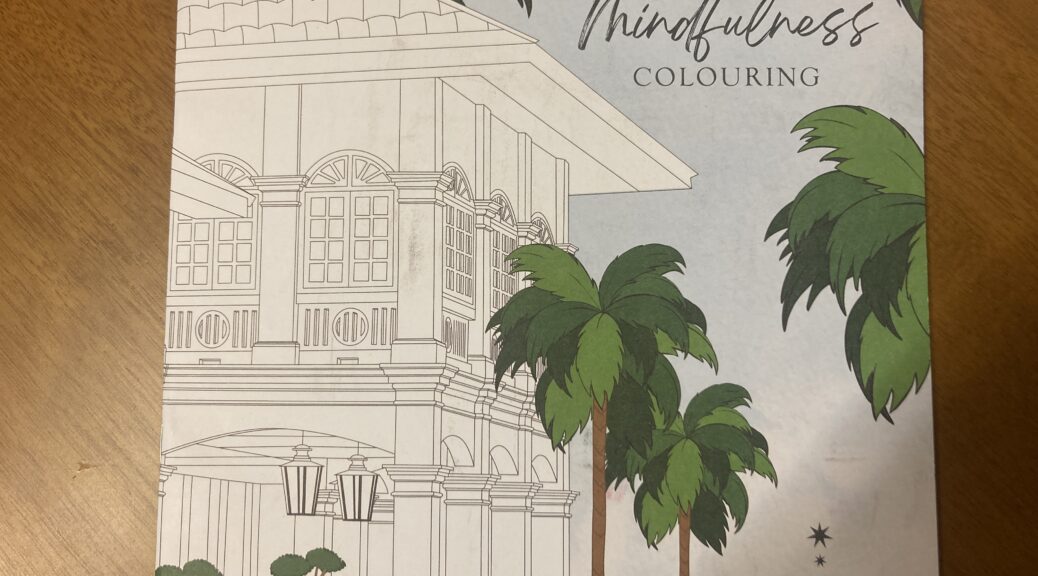
Among many guest activities, one of my favorite is to color adult coloring books. For instance, Capella hotel at Singapore, offered me a coloring book with colored pencils.

While I was coloring, I focused on a simple activity. This began to relax my brain and quiet my mind. Thankfully, I could stop my racing thoughts when trying to sleep at night. Some studies have shown that focusing on the complex structure of the coloring page can help put our mind into a meditative state.
Quiet your mind with a therapeutic colouring session.
A form of Minduflness-Based Art Therapy, colouring can temporarily draw your attention away from the hustle and bustle of our everyday lives while unplugging ourselves from the digital world.
Now sit back, pick a colour and let loose.

***
Reference
Mantzios, M., & Giannou, K. (2018). When did coloring books become mindful? Exploring the effectiveness of a novel method of mindfulness-guided instructions for coloring books to increase mindfulness and decrease anxiety. Frontiers in psychology, 9, 56.
Abstract
Mindfulness has been associated with the use of coloring books for adults; however, the question of whether they do increase mindfulness has not been addressed. In two studies, we attempted to identify whether mindfulness is increased, and whether there is a need for ongoing guidance while coloring, similar to mindfulness meditation. In the first randomized controlled experiment, university students (n = 88) were assigned to an unguided mandala coloring group (i.e., described in mainstream literature as a mindfulness practice) or to a free-drawing group. Measurements of state mindfulness and state anxiety were taken pre- and post- experiment. Results indicated no change in mindfulness or anxiety. In the second randomized controlled experiment, university students (n = 72) were assigned to an unguided mandala coloring group (i.e., same as Experiment 1), or, to a mindfulness-guided coloring group (i.e., same as the unguided coloring group with a mindfulness practitioner guiding participants as in mindfulness breathing meditation, with instructions modified and applied to coloring). Results indicated that the mindfulness-guided mandala coloring group performed better in decreasing anxiety, but no change was observed in mindfulness. Exit interviews revealed that some participants did not like the voice guiding them while coloring, which suggested further differing and significant findings. While mindfulness-guided coloring appears promising, guidance or instructions on how to color mindfully may require further development and adjustment to enhance health and wellbeing.
I first picked up a coloring book at a temple stay. It was around 8 PM in a small room deep in the mountains — quiet enough that my hand just started moving on its own, and before I knew it, a good amount of time had passed. That was when I realized something felt different from all the times I had given up at home.
The author shares his experience with a coloring book at Capella Hotel in Singapore, noting that it helped quiet his racing thoughts before sleep. I agree that coloring books deserve a place among hotel guest activities — but with one condition: the effect only works when both the difficulty of the book and the environment around it are right.
First, difficulty. Every time I open a coloring book at home, the same thing happens. When the design is too complex, I have no idea what color goes where, and even after filling in a section, there is always more left — no sense of accomplishment, so I end up closing it halfway. But with a simple design, my hand moves naturally and time slips by without me noticing. This connects to Csikszentmihalyi’s Flow theory. Flow happens when difficulty and skill are in balance, and a complex design breaks that balance before the experience even begins. The study cited by the author (Mantzios & Giannou, 2018) found that unguided coloring had little effect on anxiety — but perhaps the issue was not the absence of a guide, but a mismatch in difficulty. A simple design can serve as its own guide, lowering the cognitive load enough for Flow to happen naturally.
But difficulty alone is not enough. At a pop-up store in Seongsu-dong, a brand handed out coloring books featuring their own products. The designs were simple enough. But the moment I sat down and opened one, the space around me was already somewhere else entirely. People moved in and out constantly, music drowned out conversation, and the seating was uncomfortable. Most of all, the space had a clear message: “Do this, then post it.” The coloring book was not a tool for relaxation — it was a prop for a photo. Expecting Flow in that environment was never a possibility. This is what Kaplan’s Attention Restoration Theory describes. Overstimulating environments continuously drain the brain’s directed attention, leaving no room for Flow to take hold.
This is why coloring books do not belong in every hotel. Guests at a casino hotel or a busy city property are already there for excitement and stimulation. Coloring books shine only when the space itself is restorative — when guests come specifically to recover and unwind.
One step further: if coloring books are most effective right before sleep, as the author experienced, hotels could design this into a bedtime ritual kit — a simple coloring book paired with chamomile or lavender tea. The combination of visual focus from coloring and the sensory calm of a warm drink creates a multisensory wind-down experience. Each element reinforces the other, making it easier to reach the relaxed state the author describes.
In the end, a coloring book is just a tool. In a quiet mountain room late at night, a simple design was all it took to reach Flow. At a noisy pop-up, even the easiest design could not get me there. Before a hotel decides which coloring book to stock, there is a more important question to ask first: does this space already tell our guests that it is okay to rest?